
This post will teach you the basics of how to properly conceptualize options in your mind.
It will then teach you how to translate the idea of what an option is into what you see in your brokerage.
This is the noob friendly post I should have started the series with :)
I say this because if you want to trade options, you need to firstly understand and be able to conceptualize what an option is.
Note: If you want to read the other parts of my series, Click Here
Simply put, options are a financial instrument.
They are not a strategy. They are not inherently better than stocks, or futures, or forex, or bonds.
They serve a particular purpose in the market, just like each of the others.
The reason many smart retail traders are attracted to options is because of what they give you exposure to.
Or more simply put*: the different ways you can make money trading them.*
As you dive deeper into the product, you will come to realize that they are an extremely versatile product that can let you express almost any view or idea you have in the market. They are pretty cool.
But in order to dive deep into options, you first need to be able to conceptualize what an option is. Let's get started.
There are 6 characteristics of an option.
Regardless of what option you are trading, they all have the same 6 characteristics that define them.
These characteristics are:
- An option is a contract
- Created between two people
- That gives the purchaser the right to buy or sell a stock
- At a set price
- In a set time frame
- For a premium
These 6 characteristics will help you conceptualize what an option is and how it works. Let's break them down!
1) An option is a contract..
When you buy or sell an option, you are not trading the stock itself. The options market is actually separate from the stock market. When you trade in the stock market, you are actually exchanging a piece of the company with others. But in the options market, when you make a trade, you are creating a contract.
2) Created between two people..
Most people think about option trading as "them VS the market". They aren't really wrong when saying that, because the market determines the prices of the options you see, but I do think people internalize that wrong.
When a we say it's "you VS the market", it's not the same as "you VS the house" at a casino.
You see, trading is not like blackjack, where all the players sit down and play against the casino.
Rather, it is more like poker, where all the players are playing against each other at the same table, betting on the events that will be unfolding.
So whenever you are placing a trade, if you break a market down to it's micro transactions, there is actually someone on the other side of that trade.
In the options market, there are two players in every transaction: The person who writes/creates the contract (seller) and the person who purchases the contract (buyer).
Whether you are the buyer or the seller, there are many different players that could be on the other side of your option contract, but we will save that for another post.
3) That gives the purchaser the right to buy or sell a stock..
The contract that the option buyer purchases gives them the right to buy or sell a stock.
This also means that by selling an option, you have an obligation to fill the order if the buyer chooses to exercise the contract.
4) At a set price..
In the options world, this is called the strike price. So for example, you might buy an option contract from someone that gives you the right to buy Apple stock at $160.
This is written into the contract. Different contracts will have different strike prices.
Now let's stop and think about this for a second. Would it make sense for an option contract to go on forever? If they did, it wouldn't really make sense to sell them (you'd have a lifetime of risk, for one time pay!).
So that brings us to the next characteristic of an option.
5) In a set time frame..
Options don't last forever. The contracts have a deadline, at which time they expire. Going back to our Apple example, you might buy an option contract that gives you the right to buy Apple at $160 in the next 30 days.
But there is one more thing we need to take into consideration. We know why someone would buy an option now. It gives them the right to buy or sell stock, at a set price, within some timeframe..
But why would anyone sell an option? Why would someone give you that right?
6) For a premium!
Purchasing options is not free. The reason someone would sell an option is because they get paid to do it.
So if we revisit our (hypothetical) Apple example, this is what the full picture would look like:
You could buy an option contract from someone that gives you the right to buy Apple at $160 in the next 30 days for a price of $15.
Now that we can visualize what an option looks like, let's learn some industry lingo.
Let's turn the picture we created into what it actually looks like when you are looking at the options market.
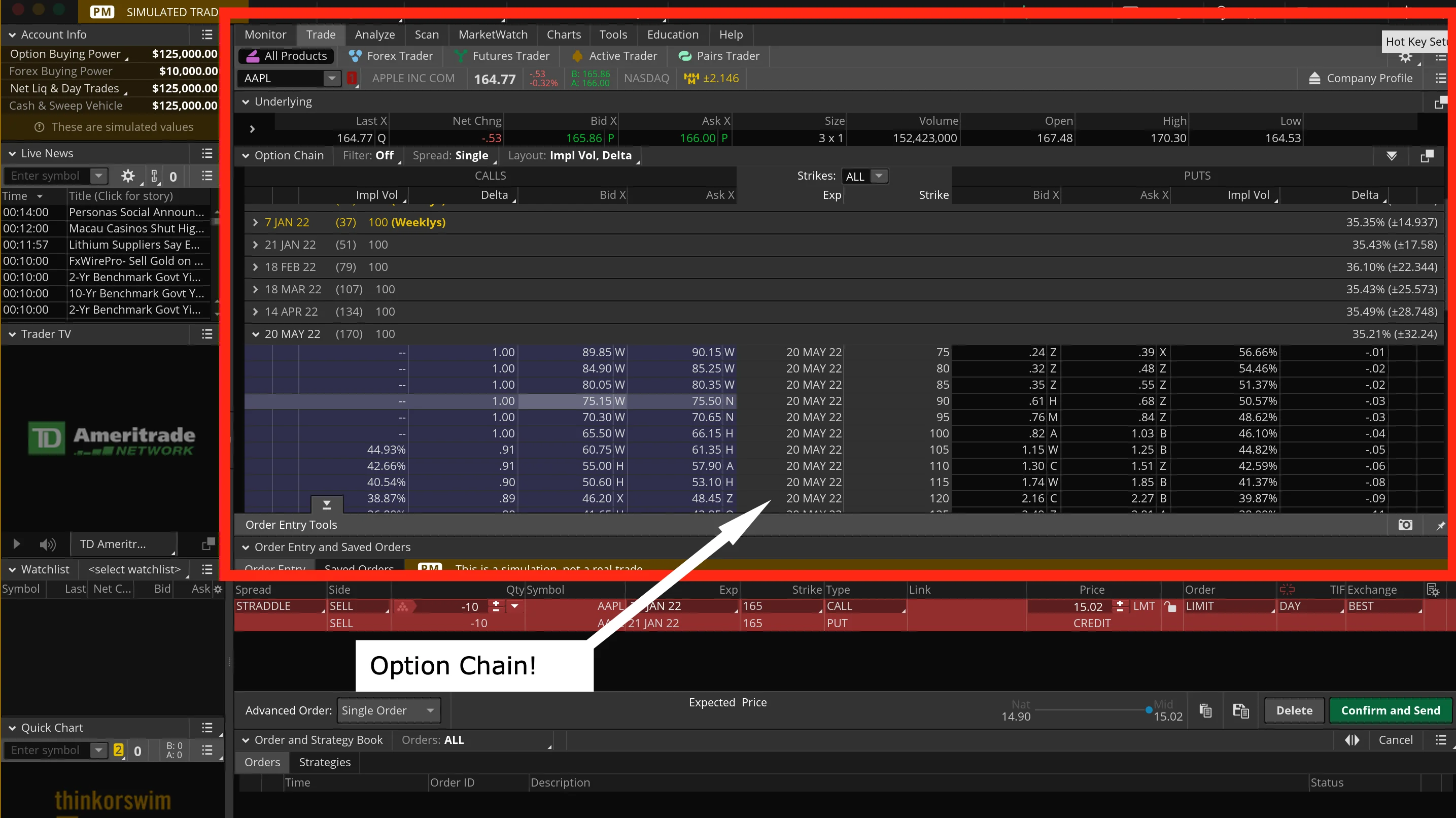
1. Contract = option chain.
You go into your brokerage to see it. It is literally a list of all the different contracts you can trade for a stock. When you want to buy or sell a contract, you come here and you pick the one you want to buy or sell.
2. 2 people = bid/ask.
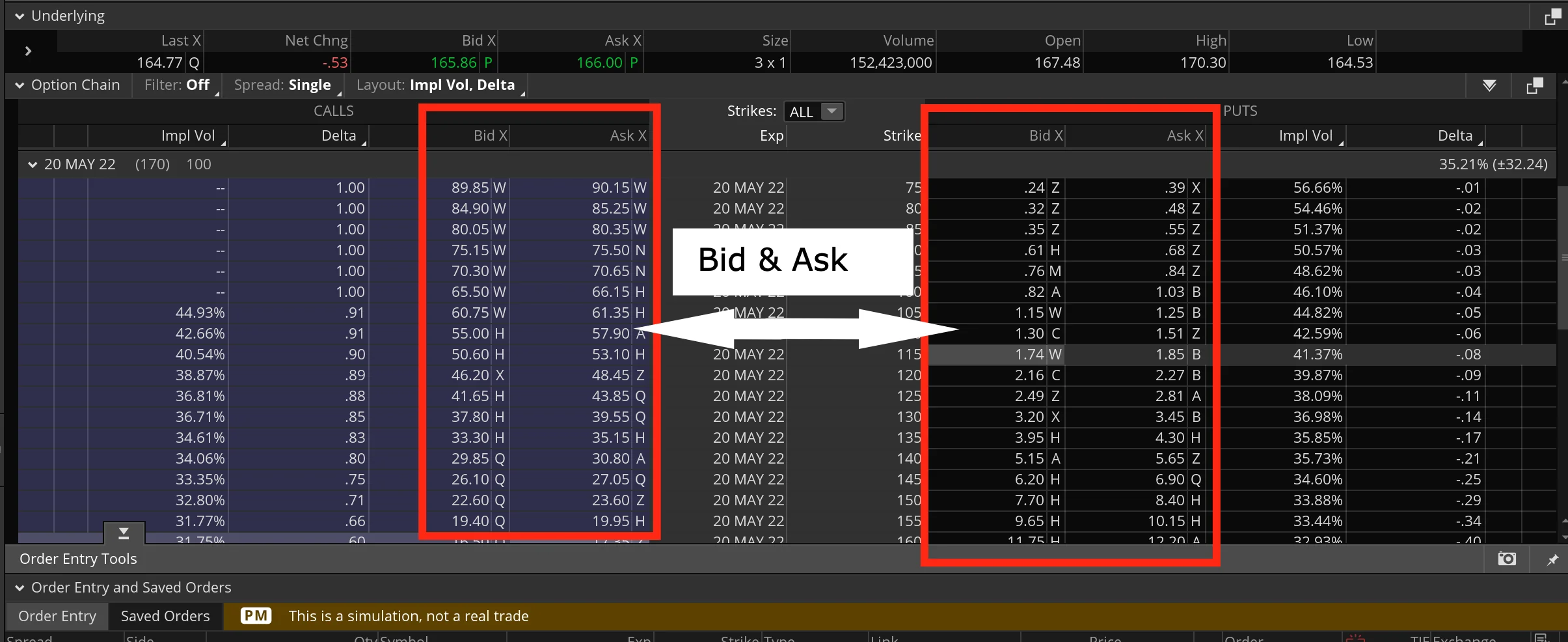
The way you can really understand that there is someone on the other side of you trade is the bid and ask. these are the prices that someone is willing to either buy a contract at (bid) or sell a contract at (ask). Every contract has a bid and an ask price.
Think of it like you are standing in a market, and someone is standing there saying "ill buy an apple contract for 1 dollar" and someone else is there saying "ill sell an apple contract for $2".
If you want to buy an option, you engage with the person on the ask side. If you want to sell an option, you engage with the person on the bid side. And sometimes, someone might actually meet you in the middle if you try to buy or sell somewhere in between those two price!
The buyers and sellers act as supply and demand for the contract, and depending on the buying and selling pressure, that's how we get the "market price" for the contract!
3. Right to buy, right to sell = calls and puts.
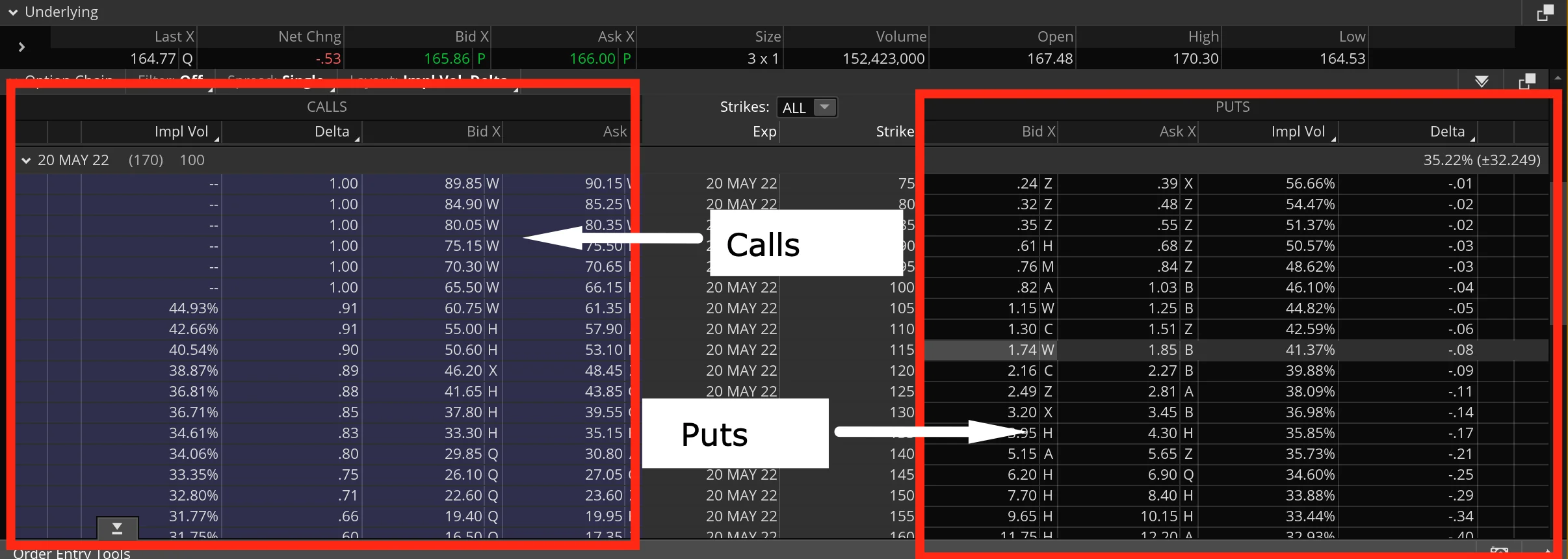
A call is what we call an option contract that gives the buyer the right to buy a stock.
A put is what we call an option contract that gives the buyer the right to sell a stock.
On most brokerage set ups, the left side of the option chain will be the calls and the right side will be the puts.
4. A given price = strike price
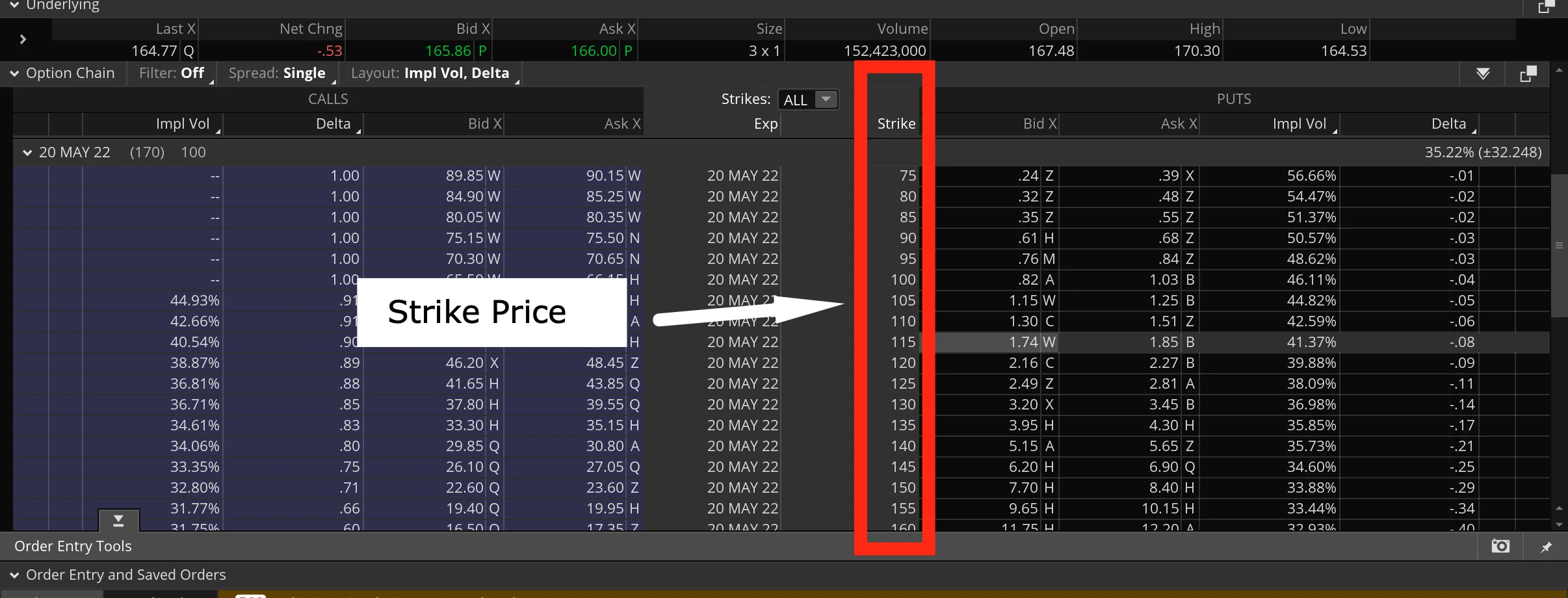
When you look at an option chain, each row is different contract that is listed. Each of these contracts that you see will have a number in the middle of the chain. $115, $120, $125... etc.
These are the prices that the contract gives the buyer the right to get the stock at! Each contract has a different stock price that the contract is based on.
Each strike price is the price you have the right to buy/sell the stock at for the options on that row.
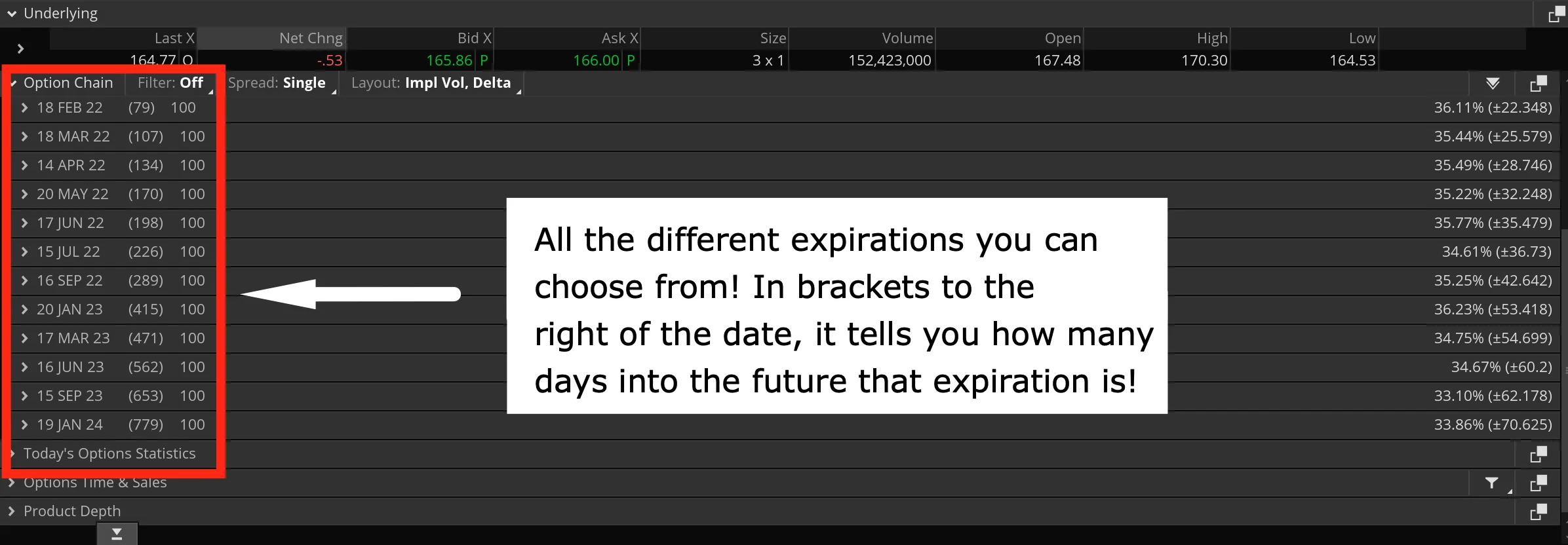
5. Time frame = expiration date
Not all option contracts expire at the same time. Depending on the stock, you could have options that expire in 1 day, 7 days, 30 days... 2 years.. the list goes on.
When you look at the option chain, you will see that there are a bunch of different contracts listed under different dates. The date you see are the expirations for those contracts!
When you select the expiration you want to look at, it will open up the list of all the options expiring on that date.
6. Premium = Price
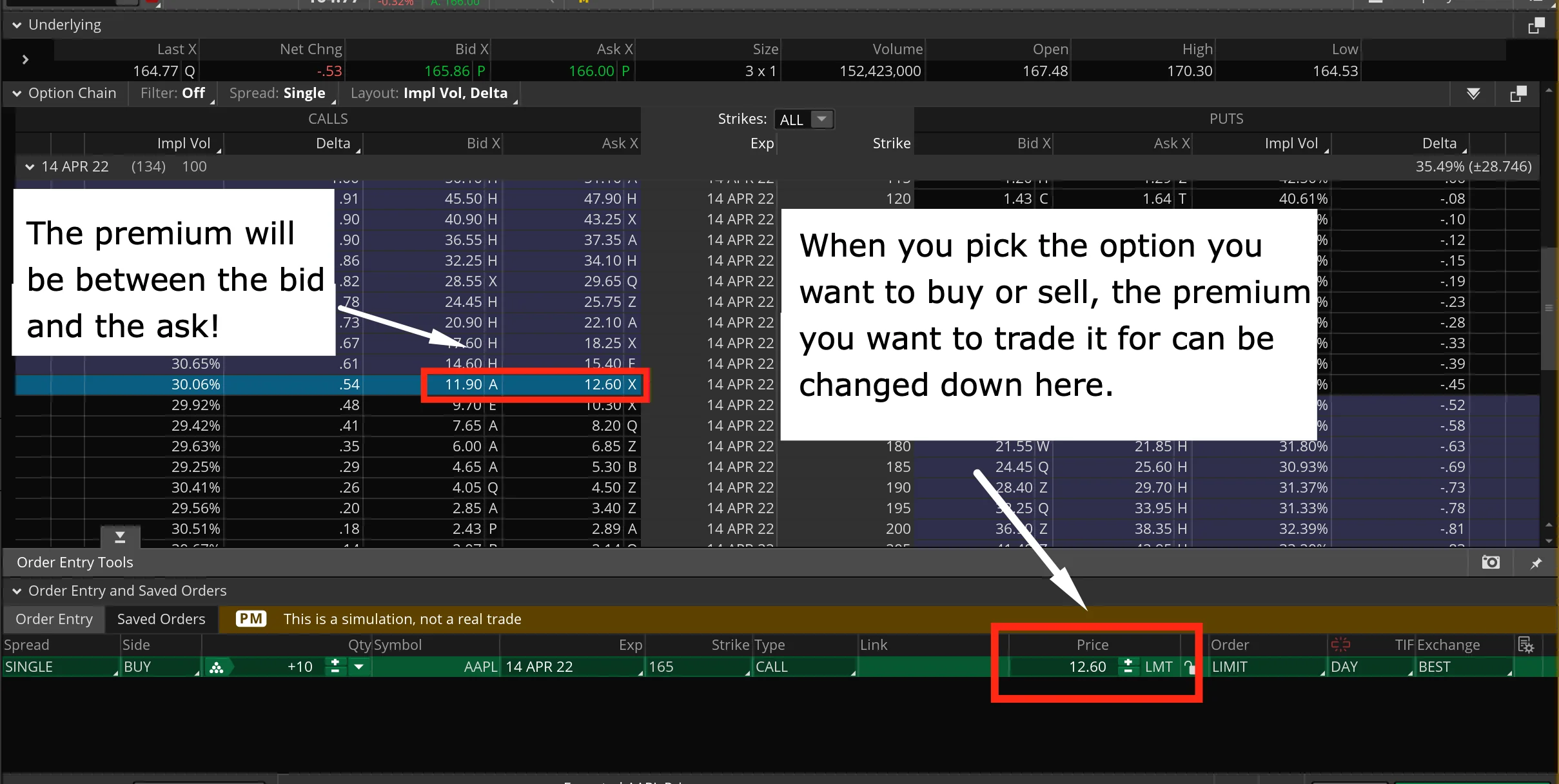
For each contract, there is a price associated with them. The price what someone is either willing to buy or sell the contracts for! Where do you see the price on the option chain? Well, it's the bid and the ask! You can see how much someone is willing to pay for a contract, or how much someone is willing to sell it for, right on your brokerage.
There is a lot that goes into pricing options, but for now, all you need to remember is that options are not free. There is a price associated with them.
Imagine you are standing in a marketplace. The bid is like osmoene else standing there looking to buy a call option for (as in the below picture) $11.90.
The ask is someone else in the marketplace saying that they will sell that same option for $12.60.
There is a gap between what the buyer wants to pay and what the seller will accept. You can sometimes purchase or sell in the middle of these two by making an offer in the middle! Trying to get something for the best price is what we call "working your order".
Conclusion
So let's recap the 6 characteristics of what an option is by writing out a sentence for our Apple example.
You want to buy a call on Apple's option chain that lets you buy Apple at a strike price of $160. The contract will expire in December 2021. There is someone willing to sell it to you at the "ask" price for that contract, for a premium of $15.
I hope this post makes it clear what an option contract is. With this as a basic understanding of how the product functions, we can move forward into some of the intricacies related to the product and the opportunities that they create.
Happy trading,
~ A.G.