
This post will teach you how delta hedging works and how to use it in your trading.
Delta hedging is an extremely important topic when we are trading options. Remember, a lot of the time we want to remain directionally neutral when trading options.
As the market changes and stock moves, so does our position. Delta hedging is how we maintain our view during this turbulence. More on this to come.
To start, a couple points about trading direction:
If we want to trade the direction, most of the time it makes more sense to trade the stock. This is because the stock only has exposure to delta, which is our exposure to a change in price of the stock.
Remember, the name of the game is to create a great view and express it well. That’s how we will get paid.
So if all we have is a delta view, it makes sense to trade a product that only has exposure to that!
Options have more exposures than delta.
We get exposure to all the greeks, which is awesome. Delta, gamma, vega, theta, etc.
If we can remove delta from the equation, then we can get exposure to what we really want, the gamma, theta, and vega (which we can’t get exposure to with the underlying). These exposures are what attracts us to options.
Here's an example to illustrate how delta hedging works:
Let's say we decide to sell a straddle, and that the underlying price is $200. We sell a 200 strike straddle.
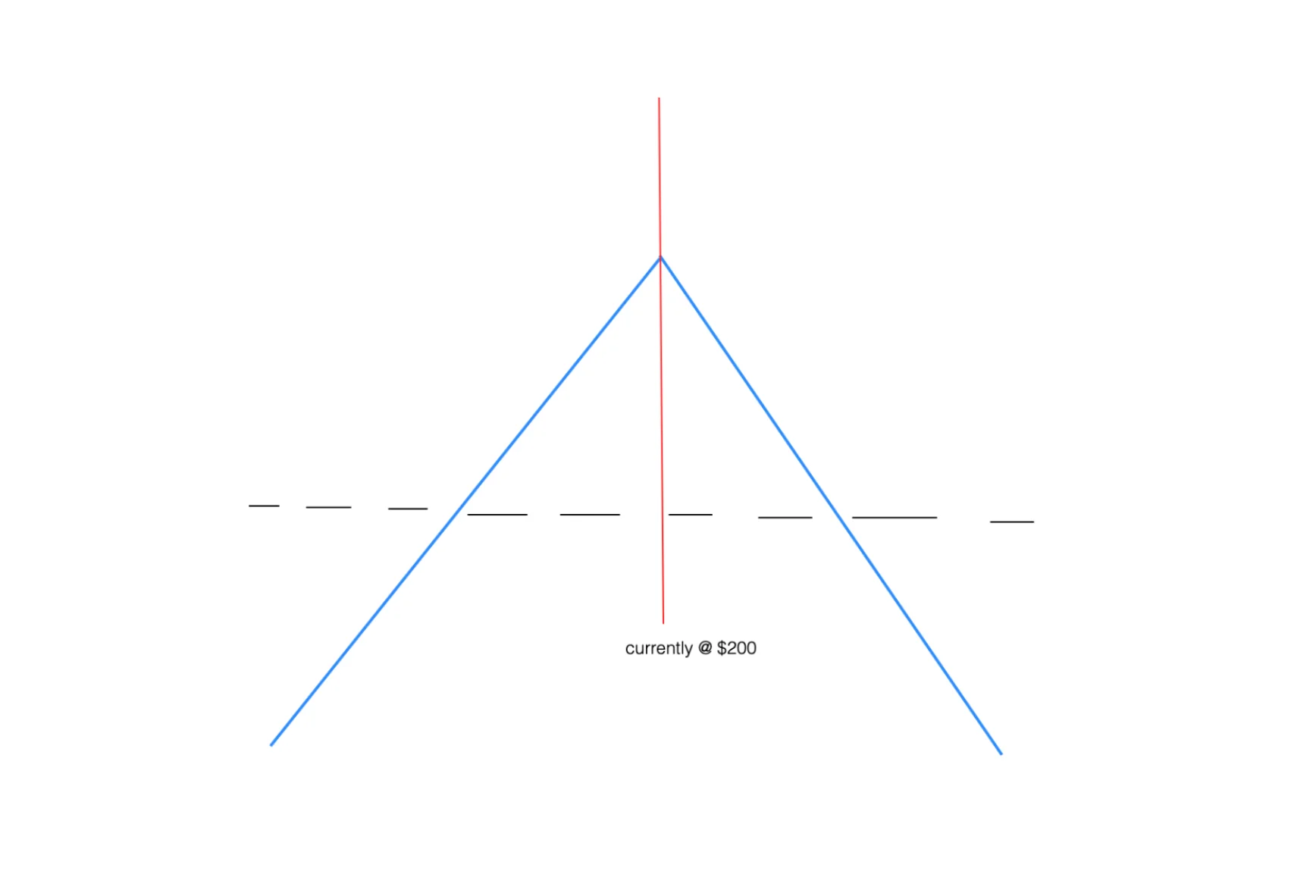
The picture below shows us what this straddle might look like.
- The black dotted line is the $0 PnL line. T
- he blue line is our PnL at expiration.
- The top of the blue line is todays price, and is also our Max PnL.
We can see that as the price moves in either direction , our PnL changes accordingly. Our breakevens are at the black dotted line.
But when you look at the PnL analyzer in your brokerage, you will also see another line.
This is a flatter looking line, and we call this our “Instantaneous” PnL. It’s what our PnL looks like right now.
The reason this is important is because you can close or open your option positions at any time.
You do not need to wait until expiration. This means that as the markets change in real time, so does your position.
Note: as we approach expiration, the instantaneous PnL will turn into the expiration PnL.
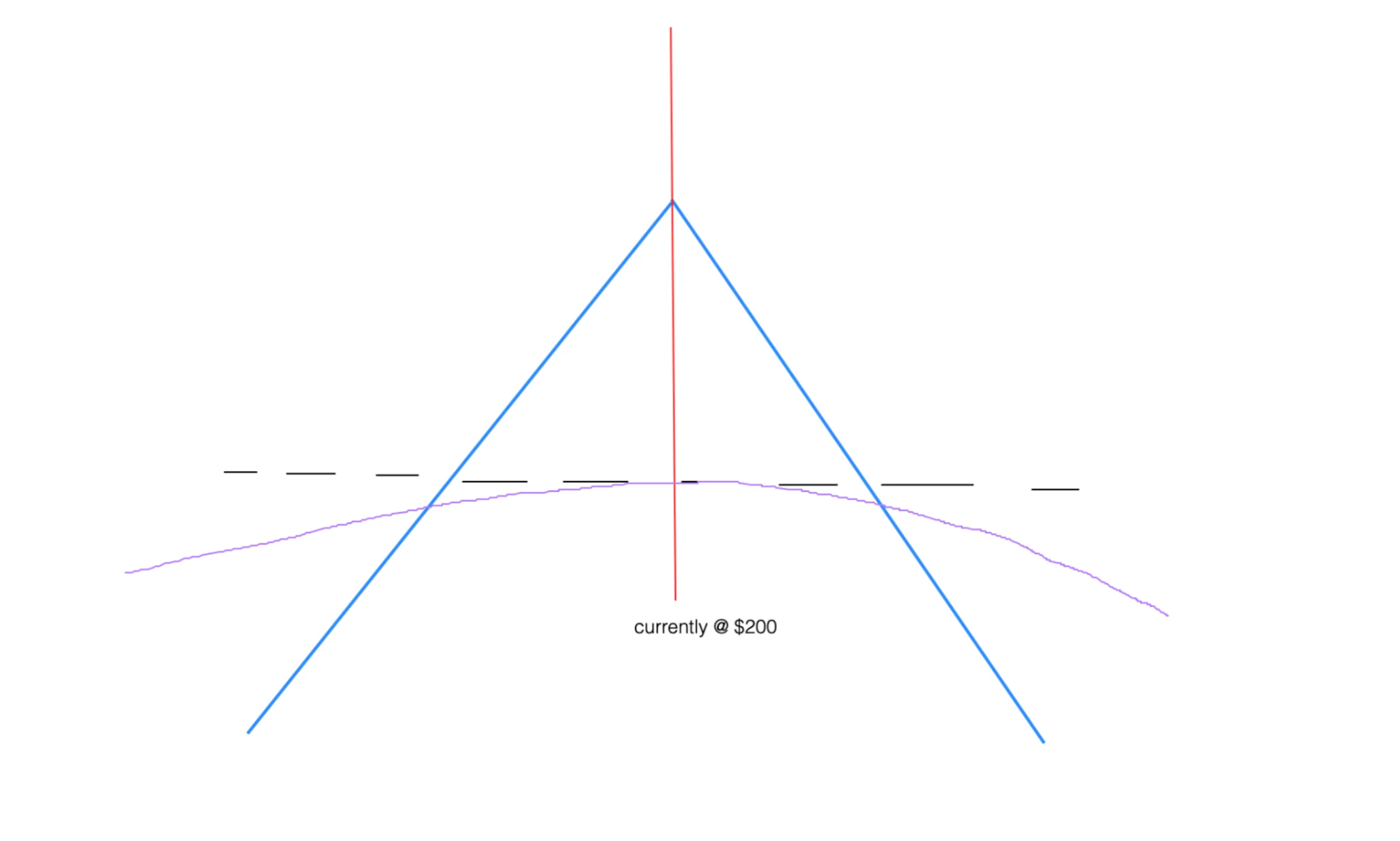
In the above picture, the purple line represents the instantaneous PnL of a trade that we put on today.
Because no time has passed, the PnL at the price we sold at is basically 0. And if the stock starts moving a lot right away, we will start to lose money.
But what do we also notice? The line is pretty flat. In fact, small moves in the stock price seem to have no impact on the PnL of our trade.
This is because when we sold the straddle, our delta exposure was 0!
This means that a change in the stock price doesn't have an impact on our PnL!
So you can see how the straddle is neutral on direction, at least at inception (meaning when you put the position on).
For the area where the instantaneous PnL is flat, we don’t care much for direction. Our exposure to it is effectively 0.
If the stock goes to $199 or $201, it doesn’t matter to us.
But what happens when the stock goes from say $200, to $210?
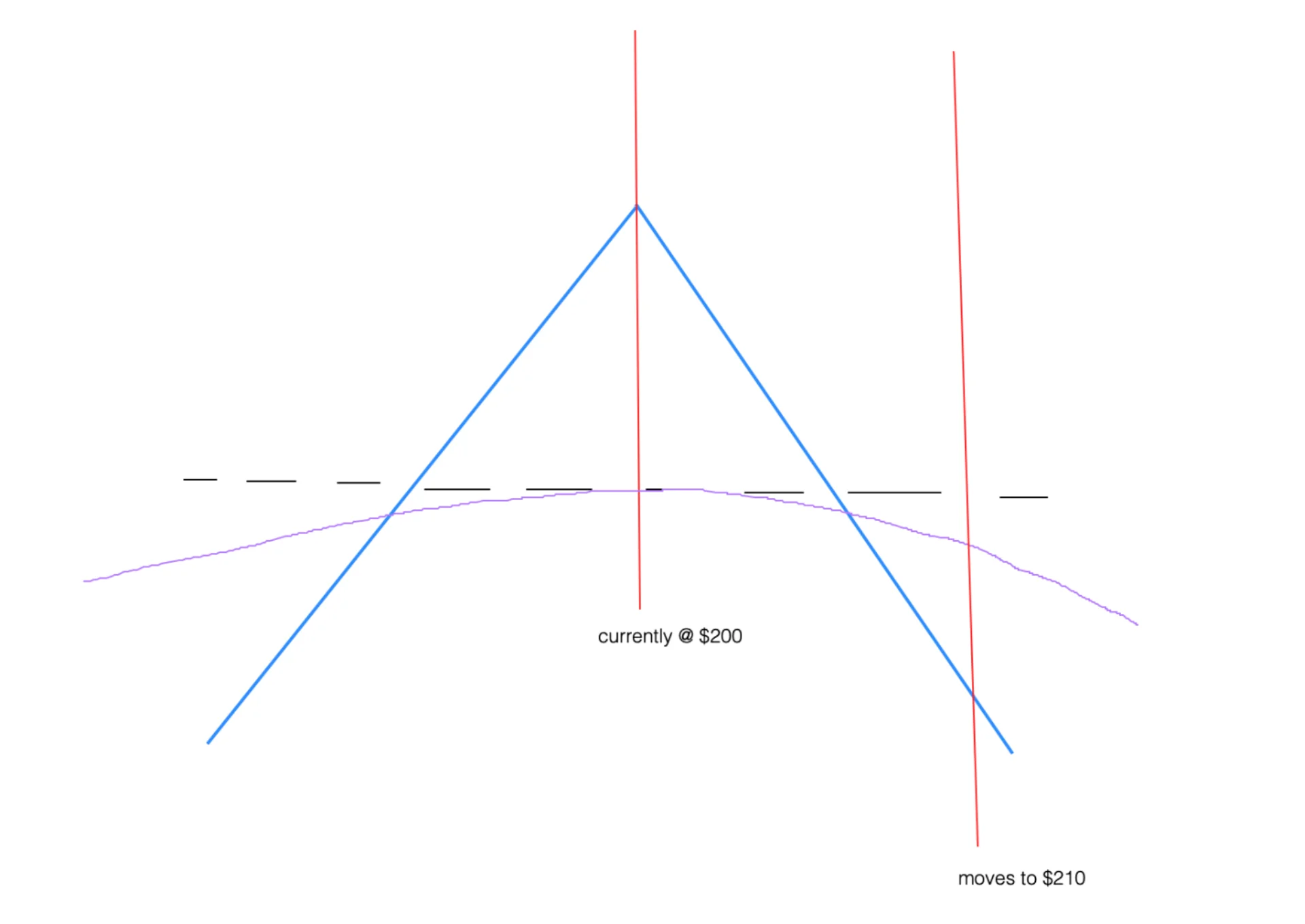
Now we are further to the right in terms of the stock price. All of a sudden, you can see that we start losing money if the stock continues to move up, and we actually make money if the stock goes down!
We are no longer directionless. We now have delta.
To be precise, we are now short delta*.* This means that we make money if the stock goes down and lose money if the stock goes up.
So what does this mean for our trade?
We originally placed this trade without a view on direction. We thought volatility was expensive, so we constructed a trade to express a view on that without direction.
But now that we are short delta, we need to either remove that risk or include it into our thesis (that we think the stock will go down).
But a lot of the times when we put this type of trade stucture on (ATM Straddle), we did it because we don’t have a view on direction.
This leaves us needing to remove the short delta we now have.
Why do we need to do this?
Because we still want exposure to the other greeks!
Even after the stock has gone up, we are still long theta, short gamma and short vega. The exposures we actually want. But we don’t want the short delta.
So how can we remove our short delta? We can buy something with long delta.
What has long delta? The stock!
Think about it. We current have a position on where if the stock goes down we make money, and if the stock goes up we lose money. So what asset can we trade that makes money if the stock goes up we make money, and if the stock goes down we lose money? The stock!
By buying stock in an amount that neutralizes our short delta, we can hedge that risk out of our position, and therefore return to our original exposures!
Returning to our example..
Let’s say after the stock moved to $210, our delta is now -50.
Meaning, we are short 50 deltas. Being short 50 deltas means that if the stock goes up a dollar, we lose $50, and if the stock goes down a dollar, we make $50.
So how can we neutralize this? We can go into the market and buy 50 shares!
Now when the stock goes up a dollar, we will lose $50 on our straddle, but at the same time we will make $50 on our 50 shares. This leads to a $0 return.
And when the stock goes down a dollar, we will make $50 on our straddle, but at the same time we will lose $50 on our 50 shares, which also leads to a $0 return.
Therefore, we can say that our new “total position” (short straddle and 50 shares) has a delta neutral exposure.
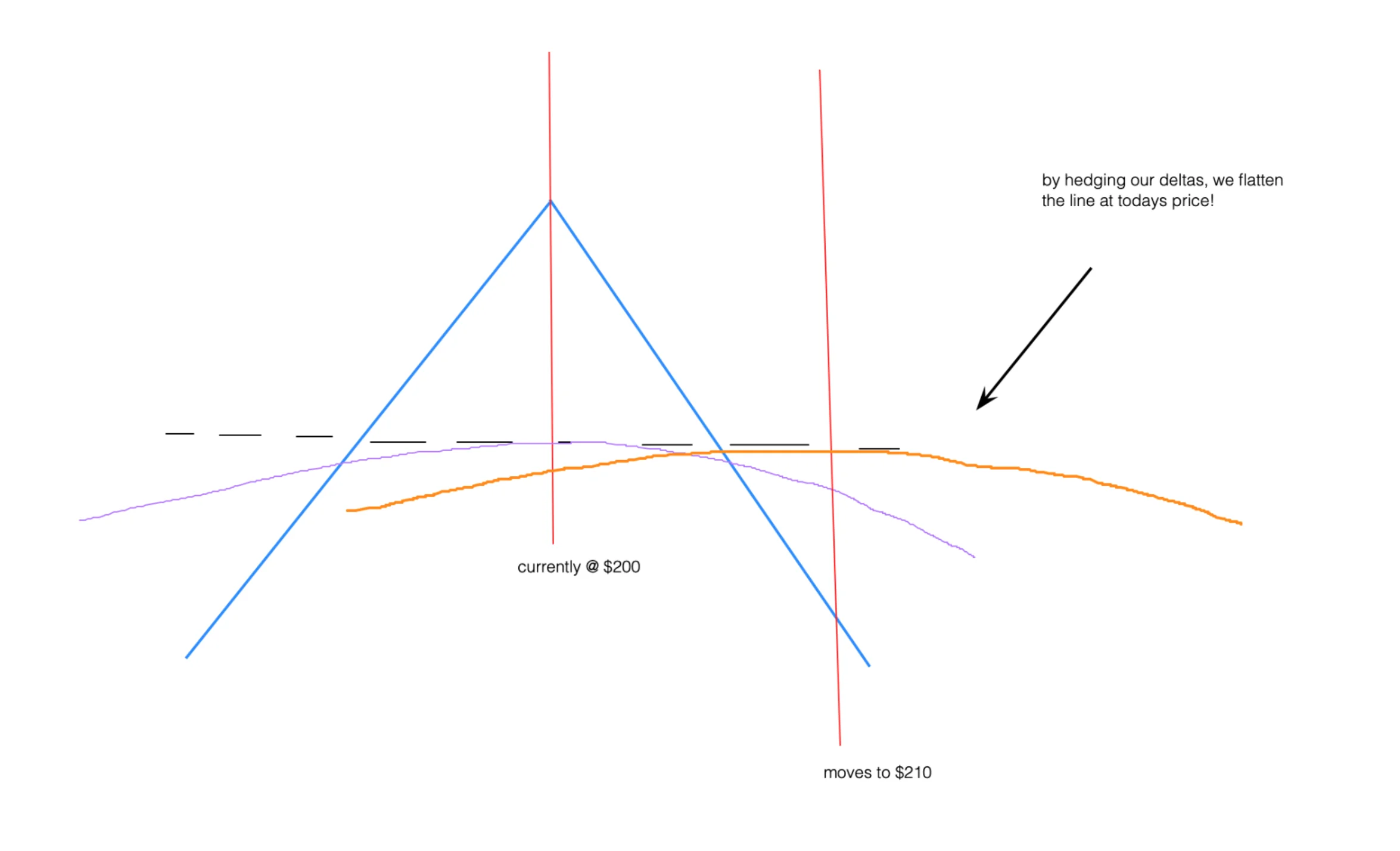
The orange line on the picture above shows what our new instantaneous PnL looks like after 1) stock moves to $210 and 2) we hedge our deltas with shares. Our instantaneous PnL is now flat around the current price, meaning we are back to delta neutral!
What we just went over is what's called delta hedging.
It allows us to stay in a position even when it starts running against us.
Going back to our example:
Let’s say that the stock continues to run. It goes from $210, to $220.
At this point, we are short 150 delta on the straddle.
What this means is that we need to go out and buy 100 more delta. Why? Because we already have 50 shares (long 50 delta). So by picking up another 100 shares, we are now back to delta neutral.
Note: depending on your brokerage, it will add up your deltas for the stock and straddle or keep it separate. This is something for you to take a look at for how yours is set up, but it;s important to be clear on how to calculate your delta exposure.
If it’s all together, your total delta exposure will be the number it shows. If the brokerage keeps it separate for the shares and straddles, you will need to do some addition/subtraction to figure out your total delta exposure.
So now we have -150 delta on our straddle, and +150 delta on our shares.
An important point:
What we don’t want to do is keep hedging if the stock just totally runs away from us. At some point, we do need to say that we are wrong. Our original thesis is that the stock will stay in a given range. So if the stock just keeps going down, and down… then we need to say we are wrong and take the loss.
We aren’t always going to be right, but delta hedging allows us to stay in a position that we believe still has edge.
But stocks don't always go up.. What if it goes back down?
What happens if the stock goes back to $210? All of a sudden, we will have -50 deltas on our straddle, and +150 delta on our shares.
We want to balance this out, so all we would do at this point is sell off 100 of our shares, bringing us to -50 deltas on the straddle, and +50 deltas on the shares (back to net 0 delta).
How often should you hedge your delta?
I am sure you are now wondering, when do I hedge my position? If my delta goes from 0 to -1, do I go and buy a share right away?
Well, it all depends on your risk tolerance.
Imagine you had -150 delta on a short straddle position. This would mean that for every dollar change in stock price, your PnL variance is $150. If your account size is $5000, that 150 deltas is pretty huge, especially if you are really trying to trade the volatility.
But what if your account is $100,000? Well then all of a sudden that number is very small. So it’s up to you to decide what delta you want to hedge at. You don’t want to hedge your deltas if it’s insignificant.
Now I know there are traders who will disagree with me on this and say “you aren’t truly trading volatility if you aren’t perfectly delta neutral” and in a sense, they are right.
They are thinking about it from a different perspective than me though, which is why this is my usual response:
If a bit of delta exposure is the difference between me making and losing money on a trade I should be looking for a better/bigger edge.
For the trades I take, the delta hedge is not the position. It allows me to stay in the trade with some variance in the underlying when I think the edge on volatility is big enough to warrant the swing.
A cool experiment with a short call option.
Let’s say we sold an at the money call on the stock from our example. We would be short a call. What would our delta exposure look like?
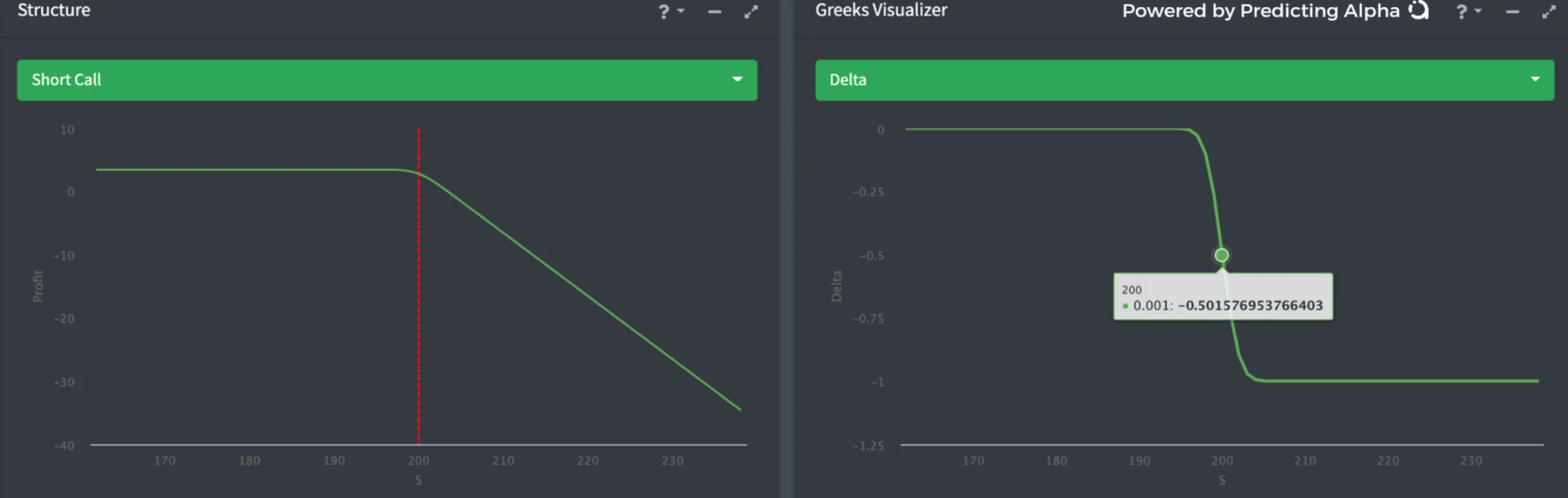
What you can see from the picture above, is that if we were short 1 call, we would be short about 50 deltas (sometimes 0.5x100, since 100 is how many shares an option is exposure to). We can also see how our delta changes at different prices.
Let's say that right away we decided to hedge our deltas, since we wanted to sell a call and hedge the deltas. Following what we covered, we would go into the market and buy 50 shares. Now check this out.
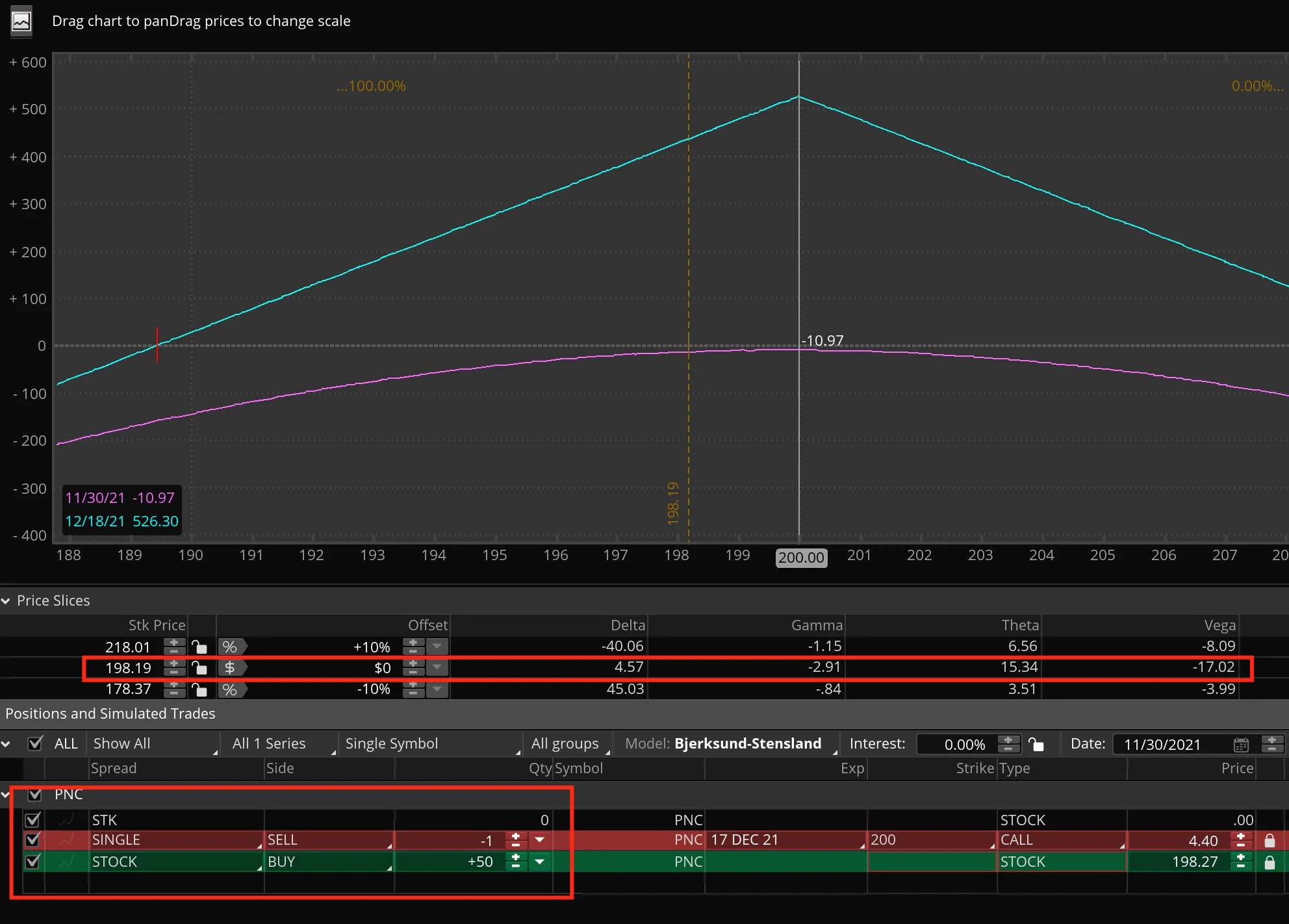
When we buy 50 shares to hedge the deltas, our call option + the 50 shares is equal to a straddle (look at the payoff chart, its a straddle!). This is because we now have the same risk exposures as the straddle, and we will get more into this in another post where we will go in depth on synthetics.
Conclusion
Delta hedging is important. There are so many times where it's been a pivotal part of realizing my expected value. Over time, I have reduced how frequently I hedge my deltas and tend to embrace some of the variance that come with that decision. I've found this to work better for me, but that doesn't mean there are other ways too.
This is just the introduction to delta hedging, in a later post we will go even deeper into the ways it works, and different strategies for implementing it in your portfolio.
Want to read the rest of my guide? I made a notion with links to each of the reddit posts.
Click here to go to the guide's "table of contents"
Happy trading,
~ A.G.